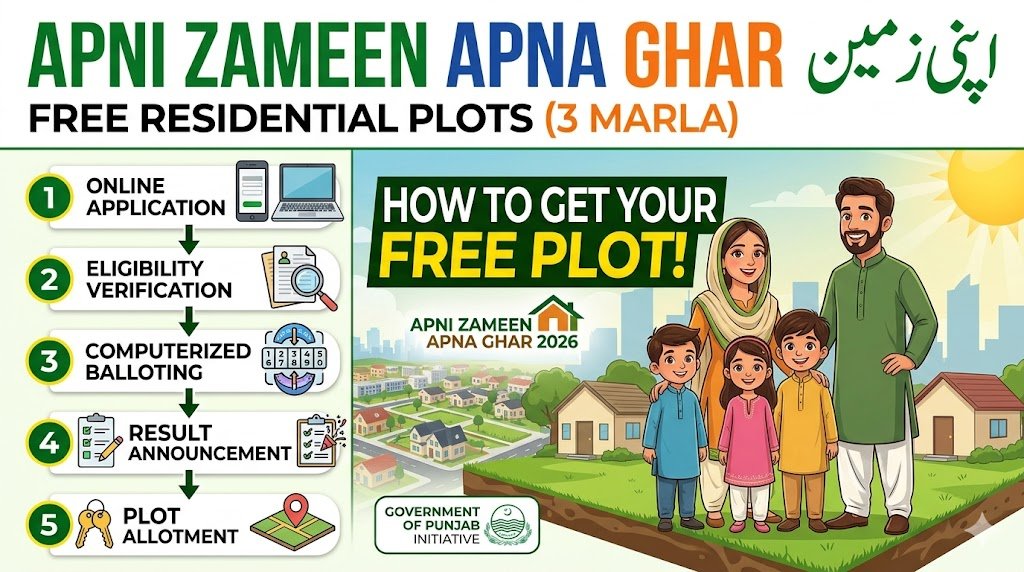
How Free Residential Plots Will Be Allocated Under Apni Zameen Apna Ghar 2026
The Apni Zameen Apna Ghar 2026 initiative has become one of the most discussed housing programs in Punjab. Designed to support families who do not own residential property, the scheme aims to provide free residential plots through a transparent and government-supervised allocation process. For thousands of low-income households, this program represents an opportunity to secure land ownership and work toward permanent housing.
The Government of Punjab introduced the program as part of its broader housing strategy for deserving citizens. Under the scheme, eligible applicants can receive a residential plot without paying the cost of the land itself. According to official government information, the plots are being distributed in phases across multiple districts of Punjab through a computerized and transparent selection system.
Quick Overview of Apni Zameen Apna Ghar 2026
| Program Feature | Details |
|---|---|
| Scheme Name | Apni Zameen Apna Ghar 2026 |
| Managing Authority | Punjab Housing & Town Planning Agency (PHATA) |
| Plot Size | 3 Marla Residential Plot |
| Cost of Plot | Free for Eligible Beneficiaries |
| Allocation Method | Computerized Balloting |
| Coverage | Multiple Districts of Punjab |
| Target Group | Low-Income and Landless Families |
The primary objective of the scheme is to help deserving families who are unable to purchase land due to rising property prices and economic challenges. The government has emphasized transparency throughout the application and allocation process.
Understanding the Plot Allocation Process
One of the most important questions applicants ask is how the free plots will actually be allocated. The allocation process has been designed to reduce human interference and ensure fairness.
After applications are submitted through the designated portal, the information provided by applicants is reviewed and verified by the relevant authorities. Verification may include checking identity records, residency status, property ownership records, and other eligibility requirements.
Only applicants who successfully pass the verification stage are considered for the next phase of the process.
Step 1: Application Submission
Applicants must submit their information through the official registration system. During this stage, personal details, family information, and supporting documents are reviewed for accuracy.
Step 2: Eligibility Verification
Government departments verify whether an applicant meets the requirements established under the scheme. This step helps ensure that benefits reach deserving households rather than individuals who already own residential property.
Step 3: District-Based Screening
Applications are reviewed according to the district in which the applicant is applying. The program follows district-specific allocations to maintain balanced distribution across Punjab.
Step 4: Computerized Balloting
When the number of eligible applicants exceeds the available plots, a computerized balloting process is conducted. This digital system randomly selects successful candidates, helping maintain transparency and equal opportunity. Government officials have already used computerized balloting in previous phases of the program.
Step 5: Plot Number Assignment
Successful applicants receive their assigned block and plot numbers after the balloting process is completed. Official allotment information is then communicated through the relevant authorities.
Who Will Receive Priority Under the Scheme?
While all applicants must satisfy the eligibility requirements, the program is intended to benefit households facing genuine housing challenges.
Reports related to the scheme indicate that special consideration is aimed at economically vulnerable groups, including low-income families and individuals who do not possess residential property. Various program updates have also highlighted support for widows, laborers, differently-abled individuals, and other deserving segments of society.
However, final selection depends on eligibility verification and the computerized allocation process rather than personal influence or manual selection.
District-Wise Distribution Strategy
The Apni Zameen Apna Ghar initiative is being implemented in phases. The first phase covers multiple districts across Punjab, ensuring that opportunities are not concentrated in a single region.
The government has announced distribution across districts including Faisalabad, Sahiwal, Okara, Jhelum, Kasur, Lodhran, Vehari, Bahawalpur, Chiniot, and several others. This district-based model is intended to spread housing opportunities more evenly throughout the province.
Applicants are generally required to apply within the schemes available in their own district, allowing local residents to benefit from housing developments planned for their area.
Why Computerized Balloting Matters
Housing schemes often attract a large number of applications. Without a transparent system, concerns about favoritism can arise. The computerized balloting model addresses this issue by relying on a digital selection mechanism.
Under this approach:
- Eligible applicants are entered into the digital draw.
- Selection occurs through an automated process.
- Human intervention is minimized.
- Records remain easier to audit and verify.
- Every eligible applicant receives a fair opportunity.
Government officials have publicly stated that computerized balloting was used during plot allocation activities conducted under the scheme, reinforcing the program’s focus on transparency.
What Happens After Plot Allocation?
Receiving a plot is only one part of the housing journey. Successful beneficiaries may need to complete additional formalities related to allotment documentation and possession procedures.
In some cases, beneficiaries may also qualify for housing support programs intended to help them construct homes on the allocated land. Government housing initiatives have referenced financial assistance options designed to support home construction for deserving families.
The overall goal is not simply land distribution but the creation of stable housing opportunities that can improve long-term living conditions for low-income households.
Key Facts About Plot Allocation
| Allocation Factor | Status |
|---|---|
| Free Plot Distribution | Yes |
| Computerized Balloting | Yes |
| Eligibility Verification Required | Yes |
| District-Based Allocation | Yes |
| Government Monitoring | Yes |
| Manual Selection Process | No |
| Priority for Deserving Families | Yes |
The Apni Zameen Apna Ghar 2026 program represents a significant housing initiative aimed at expanding land ownership opportunities for deserving residents of Punjab. Through eligibility screening, district-level planning, and computerized balloting, the government has established a framework intended to ensure that free residential plots are distributed fairly and transparently among qualified applicants.
How Applicants Can Improve Their Chances of Successful Verification
Many people mistakenly believe that registration alone guarantees a free plot. In reality, the verification stage plays a critical role in determining whether an application moves forward for consideration.
Applicants should ensure that all submitted information matches official government records. Any inconsistency in identity details, family information, or residential records may delay processing or result in disqualification during the screening phase.
Authorities generally review several factors, including:
| Verification Area | Purpose |
|---|---|
| National Identity Information | Confirms applicant identity |
| Residential Details | Verifies district eligibility |
| Property Ownership Records | Confirms landless status |
| Family Information | Checks application accuracy |
| Supporting Documents | Validates eligibility claims |
Accurate information helps officials complete the verification process more efficiently and reduces the possibility of application issues.
Why the Government Is Focusing on Land Ownership
Housing affordability has become a growing concern for many families across Punjab. Rising land prices and construction costs have made homeownership difficult for households with limited financial resources.
The Apni Zameen Apna Ghar program addresses one of the biggest barriers to homeownership: access to residential land. By providing plots without charging land costs, the scheme allows beneficiaries to focus future resources on building a house rather than purchasing property.
Government housing experts often identify land ownership as the first step toward long-term housing security. Families that own land generally have greater stability and can invest gradually in home construction according to their financial capacity.
Common Reasons Applications May Be Rejected
Not every application proceeds to the balloting stage. Applications that fail to satisfy eligibility conditions may be excluded during verification.
Some common issues that can affect eligibility include:
- Incorrect personal information.
- Incomplete application records.
- Ownership of residential property.
- Submission of inaccurate supporting documents.
- Failure to meet district-related requirements.
- Duplicate applications.
Applicants are encouraged to review all information carefully before final submission to avoid unnecessary complications.
Expected Benefits for Successful Beneficiaries
The impact of receiving a residential plot extends beyond simple land ownership. For many families, it creates opportunities that were previously out of reach.
Potential benefits include:
Greater Housing Security
Families gain legal access to residential land, reducing uncertainty about future housing arrangements.
Opportunity to Build a Permanent Home
Beneficiaries can gradually construct homes according to their financial circumstances instead of remaining dependent on rented accommodation.
Long-Term Asset Creation
Land ownership provides families with a valuable asset that can support future financial stability.
Improved Community Development
New housing schemes often encourage infrastructure growth, including roads, utilities, educational facilities, and public services in surrounding areas.
Transparency Measures Introduced for Plot Distribution
Public trust is essential for any large-scale housing program. To strengthen confidence in the allocation process, authorities have incorporated several transparency mechanisms.
These measures include:
| Transparency Feature | Purpose |
|---|---|
| Digital Registration | Reduces paperwork errors |
| Centralized Records | Improves monitoring |
| Eligibility Screening | Prevents misuse |
| Computerized Draws | Ensures fairness |
| Official Announcements | Provides public visibility |
| Government Oversight | Enhances accountability |
The use of technology helps reduce manual intervention while creating a more structured and verifiable allocation system.
What Makes Apni Zameen Apna Ghar Different From Traditional Housing Schemes?
Many housing projects focus on selling residential plots through installment plans or market-based pricing. The Apni Zameen Apna Ghar initiative follows a different model.
Instead of requiring beneficiaries to purchase land, the scheme is designed specifically for individuals who may not have the financial capacity to enter conventional property markets.
Key distinctions include:
| Traditional Housing Projects | Apni Zameen Apna Ghar 2026 |
|---|---|
| Plot Purchase Required | Free Plot Allocation |
| Market-Based Pricing | Welfare-Oriented Approach |
| Buyer-Funded Land Cost | Government-Supported Land Distribution |
| Commercial Objectives | Social Development Objectives |
| Open Market Access | Eligibility-Based Selection |
This distinction explains why the scheme has attracted significant public interest across Punjab.
Frequently Asked Questions
Is every applicant guaranteed a plot?
No. Applicants must first satisfy eligibility requirements and successfully pass the verification process. If eligible applications exceed available plots, computerized balloting is used.
Are plots allocated manually?
No. Official information indicates that computerized balloting is used when necessary to ensure transparent selection.
Can applicants from any district apply?
Applications are generally linked to districts where approved schemes are available. Applicants should follow the official guidelines applicable to their area.
Is there a cost for the residential plot?
The program is designed around free residential plot allocation for eligible beneficiaries. However, applicants should always review official announcements for updated details regarding documentation or administrative requirements.
Why is verification important?
Verification helps ensure that benefits reach deserving families and prevents misuse of public welfare resources.
Economic and Social Impact of the Program
Large-scale housing initiatives can generate benefits beyond individual households. When new residential communities are developed, local economies often experience increased activity through construction, transportation, retail services, and infrastructure development.
Potential long-term outcomes include:
- Increased homeownership among low-income families.
- Improved living conditions in underserved communities.
- Growth in local economic activity.
- Better access to planned residential infrastructure.
- Expansion of organized housing developments.
These outcomes align with broader efforts to improve housing accessibility and support sustainable community growth across Punjab.
Important Points Applicants Should Remember
Before applying, individuals should keep several important considerations in mind:
| Important Reminder | Explanation |
|---|---|
| Submit Accurate Information | Incorrect details can create verification issues |
| Follow Official Guidelines | Requirements may vary by scheme |
| Keep Documents Ready | Verification may require supporting records |
| Monitor Official Updates | New phases may be announced periodically |
| Avoid Unofficial Sources | Depend on government information only |
| Complete Registration Carefully | Errors can affect eligibility reviews |
Understanding these factors can help applicants navigate the process more effectively and reduce avoidable mistakes during registration and verification stages.
The Apni Zameen Apna Ghar 2026 initiative is structured around eligibility checks, transparent screening procedures, district-based implementation, and computerized plot allocation. Through these mechanisms, the program seeks to provide fair access to residential land for deserving households while maintaining accountability throughout the distribution process.