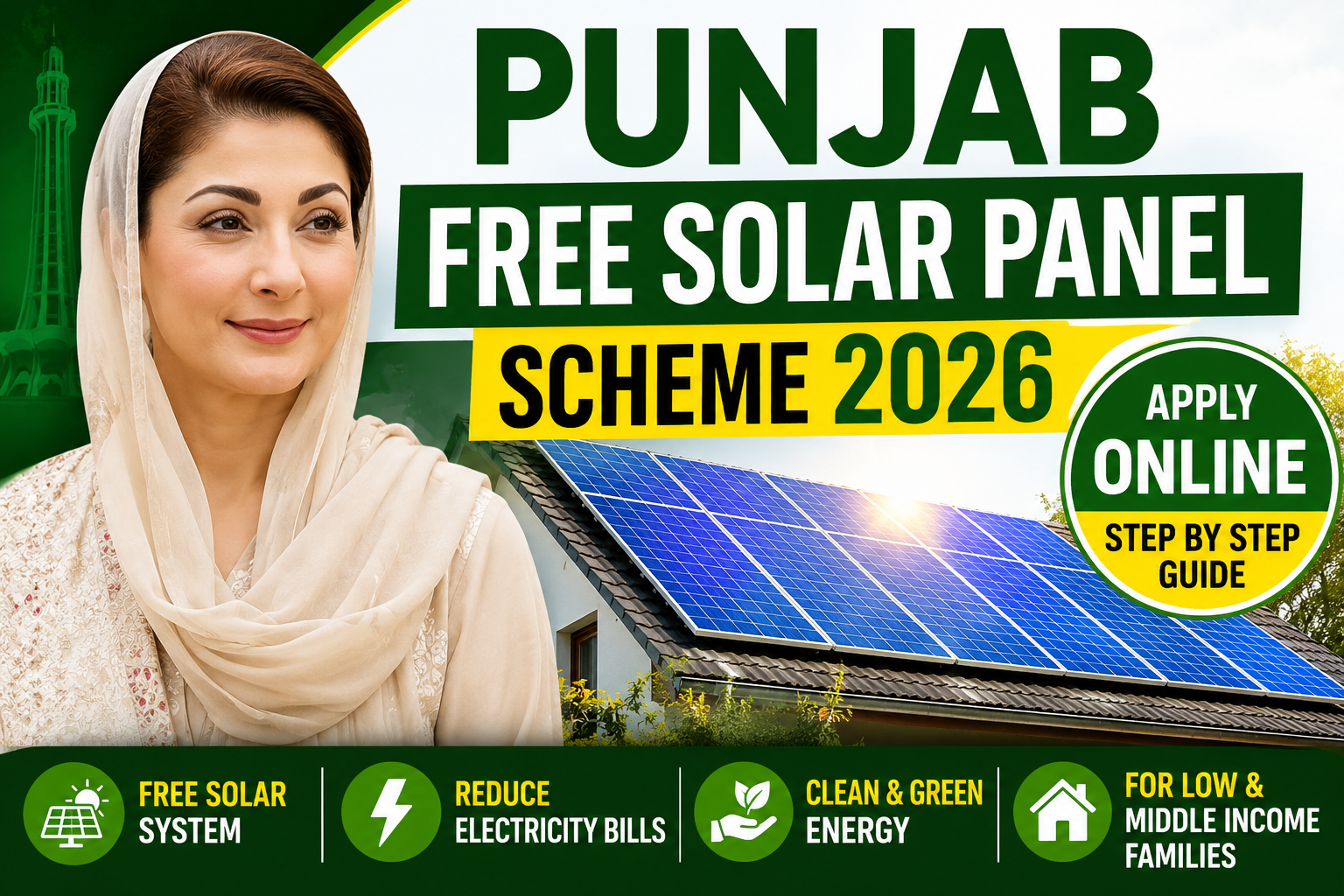
Introduction to Punjab Free Solar Panel Scheme 2026
The demand for electricity in Punjab has increased rapidly over the past few years due to rising household consumption, small business expansion, and increasing energy costs. To support low and middle-income families, the Government of Punjab has introduced a renewable energy initiative commonly referred to as the Punjab Free Solar Panel Scheme 2026. The purpose of this program is to reduce dependence on the national grid and help citizens manage their electricity bills through solar energy solutions.
This scheme focuses on providing subsidized or fully funded solar systems to eligible households, especially those facing high electricity bills or frequent load-shedding issues. The initiative also encourages the adoption of clean energy, which contributes to environmental protection and long-term energy sustainability.
Unlike traditional electricity support programs, this scheme is designed to empower households with independent energy generation. Once installed, solar panels allow users to generate their own electricity during daylight hours, significantly reducing monthly expenses.
Objectives of the Solar Panel Scheme
The Punjab Free Solar Panel Scheme 2026 is structured around several key objectives that reflect both economic and environmental priorities.
- Reduce electricity costs for low-income families
- Promote renewable energy usage across Punjab
- Decrease pressure on the national power grid
- Support rural and urban households with stable electricity access
- Encourage long-term energy independence
- Reduce carbon emissions from fossil fuel-based power generation
These goals highlight a shift toward sustainable development and modern energy solutions in the region.
Who Can Apply for the Scheme?
Eligibility is one of the most important parts of the application process. The scheme is primarily targeted at households that meet specific financial and usage criteria.
Below is a simplified eligibility table for better understanding:
Eligibility Criteria Table
| Requirement Category | Details |
|---|---|
| Residency | Must be a permanent resident of Punjab |
| Electricity Usage | Typically low to moderate monthly consumption |
| Income Level | Low or middle-income household category |
| Electricity Connection | Valid residential electricity meter |
| Property Type | Own house or legal residence permission |
| National Identity | Valid CNIC required for verification |
Applicants who fall into high electricity consumption categories may not qualify for free installation but could still be eligible for partial subsidies under related energy programs.
What the Scheme Offers
The solar panel initiative is not limited to just panels. It includes a complete basic setup designed for household energy needs.
Most installations under this program may include:
- Solar photovoltaic panels
- Inverter system
- Battery storage unit (in selected cases)
- Installation and wiring support
- Basic maintenance guidance
The system size depends on household energy consumption and eligibility category. In many cases, smaller homes receive systems designed to run essential appliances such as lights, fans, and small electronics.
Online Application Process Overview
The application process for the Punjab Free Solar Panel Scheme 2026 is expected to be handled through an online portal to ensure transparency and accessibility. While exact steps may vary depending on official updates, the general procedure remains structured and user-friendly.
Step-by-Step Application Flow
- Visit the official government energy or scheme portal
- Create an account using CNIC and mobile number
- Fill out the application form with household details
- Enter electricity bill reference number
- Upload required documents
- Submit application for verification
- Wait for eligibility confirmation via SMS or portal status
Applicants are advised to ensure all submitted information is accurate to avoid delays in verification.
Required Documents
To complete the application successfully, certain documents are necessary for identity and eligibility verification.
Commonly required documents include:
- Copy of CNIC (front and back)
- Recent electricity bill
- Proof of residence (if required)
- Mobile number registered under applicant’s name
- Household income declaration (if applicable)
These documents help authorities verify eligibility and ensure fair distribution of solar systems.
Selection and Verification Process
After submission, applications go through a verification phase. During this stage, data is cross-checked with electricity providers and national identity records.
The selection process typically follows these steps:
- Initial screening based on eligibility criteria
- Data verification through utility records
- Household assessment (in some cases)
- Final approval list preparation
- Notification via SMS or online dashboard
Only verified applicants proceed to the installation phase.
Importance of Solar Energy in Punjab
Solar energy is becoming an essential part of Pakistan’s energy strategy. Punjab, with its high sunlight exposure throughout the year, is particularly suitable for solar installations.
Key benefits include:
- Consistent energy production in sunny weather
- Reduced dependency on fuel-based electricity
- Lower long-term electricity costs
- Environmentally friendly energy generation
- Improved energy access in rural areas
The shift toward solar energy also supports national goals for renewable energy expansion and sustainability.
Common Reasons for Application Rejection
Not all applications are approved. Some common reasons for rejection include:
- Incorrect CNIC or billing information
- High electricity consumption category
- Missing documents
- Non-resident status in Punjab
- Duplicate applications from the same household
Applicants are encouraged to double-check all details before submission to avoid rejection.
Application Tips for Better Approval Chances
While the process is straightforward, careful preparation can improve approval chances.
Helpful tips include:
- Ensure electricity bill details match CNIC records
- Use an active mobile number for communication
- Provide clear and valid document scans
- Avoid multiple applications from one household
- Review eligibility criteria before applying
Expected Installation Timeline and On-Ground Process
Once an application is approved under the Punjab Free Solar Panel Scheme 2026, the installation phase begins in a structured sequence. The government usually coordinates with certified energy contractors and technical teams to ensure proper setup and safety compliance.
The installation process is generally divided into multiple stages:
- Site inspection at the applicant’s residence
- Technical evaluation of roof space and sunlight exposure
- System design based on household electricity needs
- Delivery of solar equipment to the location
- Physical installation of panels and electrical components
- Final testing and system activation
In most cases, the full installation process may take several days to a few weeks depending on workload, location accessibility, and system availability.
Solar System Capacity Breakdown
Different households receive different system capacities based on electricity usage patterns and eligibility level. The aim is to distribute resources fairly while maximizing energy efficiency.
System Capacity Overview Table
| Household Category | Estimated Load Support | Solar System Size | Typical Usage Coverage |
|---|---|---|---|
| Low Usage Homes | Basic lighting + fans | 1kW – 2kW | Small rooms, minimal appliances |
| Medium Usage Homes | Standard household load | 3kW – 5kW | Fans, lights, TV, small fridge |
| Higher Eligible Homes | Extended appliance use | 6kW – 7kW | Multiple rooms, appliances support |
This distribution helps ensure that energy production matches actual household demand without unnecessary overload or waste.
Financial Structure and Subsidy Model
Although the program is widely referred to as a free solar panel scheme, the financial structure may vary depending on household eligibility and government funding phases.
The support system generally includes:
- Full subsidy for extremely low-income families
- Partial subsidy for middle-income households
- Installment-based support in selected cases
- Government-covered maintenance for a limited period
This flexible structure allows more families to benefit while keeping the program financially sustainable for long-term expansion.
Technical Components Used in the System
Each solar installation under the scheme is designed using standard renewable energy components. These parts work together to convert sunlight into usable electricity.
Main Components List
- Solar photovoltaic panels for energy capture
- Grid-tied or hybrid inverter for power conversion
- Mounting structure for roof installation
- Wiring and safety breakers
- Optional battery storage unit for backup supply
- Net metering setup (in eligible cases)
The combination of these components ensures stable performance during daylight hours and backup availability where storage is included.
Maintenance and Performance Monitoring
After installation, system performance depends on proper care and regular monitoring. Although solar systems are generally low-maintenance, periodic checks are still recommended.
Common maintenance practices include:
- Cleaning solar panels to remove dust and debris
- Checking inverter status indicators
- Inspecting wiring connections for safety
- Monitoring daily energy production levels
- Ensuring battery health (if installed)
In many cases, technical teams may also provide scheduled maintenance visits during the initial warranty period.
Common Technical Challenges and Solutions
Even though solar systems are reliable, users may experience minor technical issues over time. Understanding these challenges helps in quick resolution.
Issue and Solution Table
| Common Issue | Possible Cause | Suggested Action |
|---|---|---|
| Low power output | Dust on panels | Clean surface regularly |
| System shutdown | Wiring fault or overload | Contact technical support |
| Battery not charging | Faulty connection or aging battery | Schedule inspection |
| Inverter error light | System imbalance | Reset or call technician |
| Reduced efficiency | Weather conditions | Wait for normal sunlight conditions |
Most of these issues are simple and can be resolved without major repairs if handled early.
Environmental and Economic Impact
The introduction of solar energy at the household level has a broader impact beyond individual savings. Punjab’s shift toward renewable energy is contributing to long-term environmental improvements.
Key impacts include:
- Reduction in electricity demand from national grid
- Lower dependence on fossil fuel power plants
- Decrease in air pollution caused by energy production
- Financial relief for families facing high electricity bills
- Promotion of clean energy awareness in rural areas
Over time, these changes support a more stable and sustainable energy ecosystem.
Role of Digital Verification System
To ensure transparency, the scheme relies heavily on digital verification mechanisms. This helps reduce manual errors and speeds up the approval process.
The digital system typically performs:
- CNIC validation through national records
- Electricity bill verification with utility companies
- Duplicate application detection
- Automated eligibility scoring
- Status updates through SMS notifications
This approach minimizes human interference and improves fairness in distribution.
Expected Expansion in Future Phases
Energy development programs in Punjab are gradually expanding as demand increases. The solar panel initiative is expected to grow in future phases with additional features and broader coverage.
Possible future enhancements include:
- Larger system capacities for small businesses
- Smart energy monitoring mobile applications
- Expanded net metering integration
- Faster installation cycles through automation
- Increased budget allocation for rural electrification
Such improvements aim to make renewable energy more accessible across all districts.
Practical Tips for Applicants After Approval
Once selected, users should take a few practical steps to maximize system efficiency and long-term performance.
Helpful recommendations include:
- Avoid shading on rooftop panels from nearby objects
- Keep inverter area ventilated and dry
- Use high-power appliances during daylight hours
- Regularly check system readings if monitoring is available
- Report any unusual system behavior immediately
These simple habits can significantly improve energy output and system lifespan.
Long-Term Value of Solar Adoption
Solar energy is not only a short-term cost-saving solution but also a long-term investment in energy independence. Households participating in this scheme benefit from reduced monthly expenses and greater control over electricity usage.
Over time, this shift contributes to:
- Stable household budgeting
- Reduced exposure to rising electricity tariffs
- Increased awareness of renewable technology
- Stronger energy resilience during load-shedding periods
The program reflects a gradual transformation in how residential energy needs are managed across Punjab.