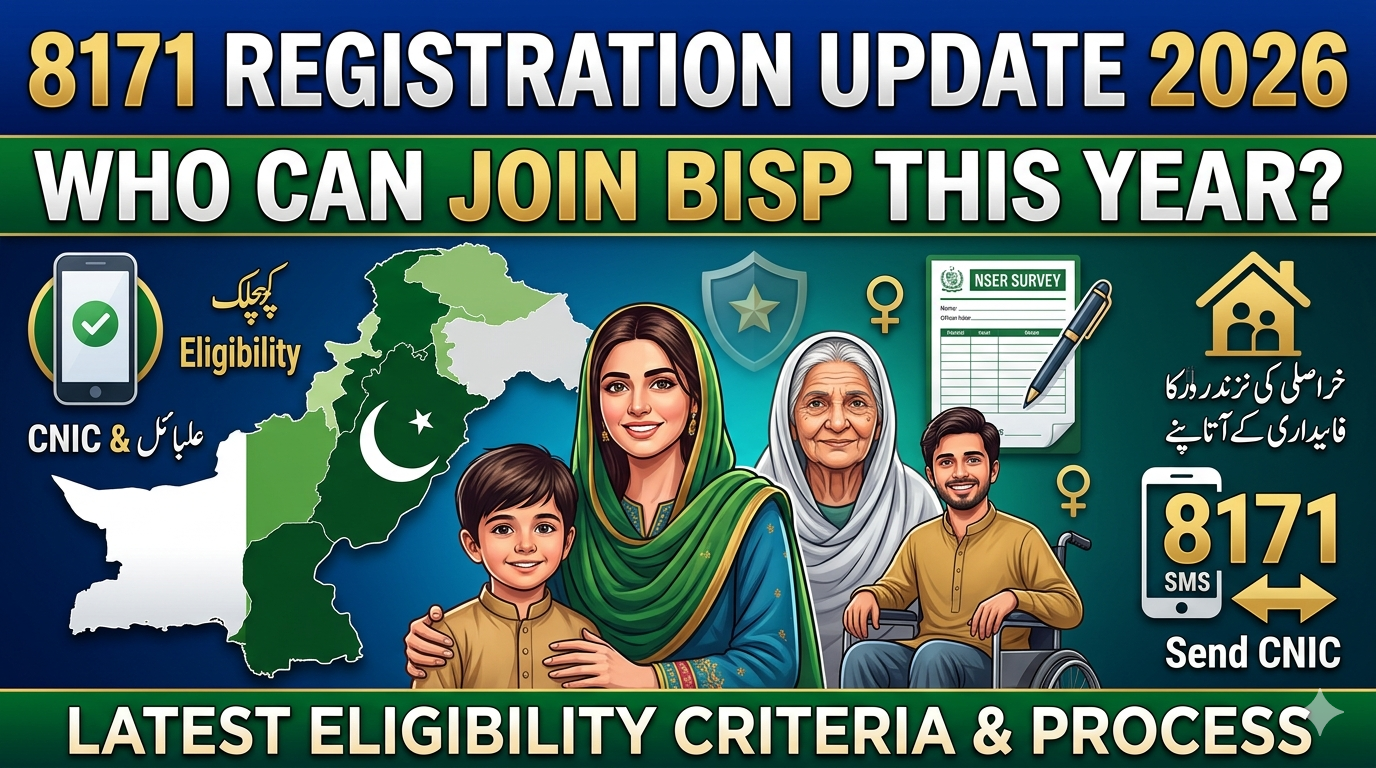
8171 Registration Update 2026: Who Can Join the BISP Program This Year?
The Benazir Income Support Programme (BISP) remains one of Pakistan’s most important social assistance initiatives, helping millions of low-income families manage everyday expenses. In 2026, many households are once again searching for information about the 8171 registration process, eligibility requirements, and the latest updates affecting new applicants.
With inflation continuing to impact household budgets, interest in BISP support has increased across both urban and rural areas. However, one of the biggest challenges for applicants is separating verified information from rumors circulating online.
This guide explains who can apply for the BISP program in 2026, how eligibility is assessed, what documents may be required, and what applicants should know before starting the registration process. Information in this article is based on current BISP registration updates and eligibility guidelines available during 2026.
Quick Overview of BISP 8171 Registration 2026
| Category | Details |
|---|---|
| Program Name | Benazir Income Support Programme (BISP) |
| Registration System | 8171 Registration & NSER Dynamic Survey |
| Main Purpose | Financial support for eligible low-income families |
| Eligibility Check | 8171 SMS Service and Official Portal |
| Required Identification | Valid CNIC |
| Registration Method | BISP Registration Centers and Survey Offices |
| Priority Applicants | Women, widows, persons with disabilities, vulnerable households |
| Verification Process | NSER Survey and Biometric Verification |
What Is the 8171 Registration System?
The 8171 system serves as the primary gateway for families seeking financial assistance through BISP. It allows eligible citizens to verify their status, receive official updates, and participate in registration and verification processes connected to the National Socio-Economic Registry (NSER).
The system was created to ensure that assistance reaches families experiencing genuine financial hardship. Instead of relying solely on applications, BISP uses household data, income indicators, and socio-economic assessments to determine eligibility.
This approach helps improve transparency while reducing errors in beneficiary selection. As a result, registration is not based on a simple application form alone. Verification remains a key part of the process.
Who Can Apply for BISP in 2026?
The program is designed for households facing financial difficulties and meeting the government’s eligibility requirements.
Generally, applicants may qualify if they fall into one or more of the following categories:
- Low-income families struggling to meet basic household needs
- Women heading households without stable financial support
- Widows facing economic hardship
- Persons with disabilities who meet program requirements
- Families already included in the NSER database
- Households affected by unemployment or reduced income
- Families identified through updated socio-economic surveys as deserving assistance
While these groups are often prioritized, final approval depends on verification results and official assessment criteria.
Why the NSER Dynamic Survey Matters
A major part of the 2026 registration process is the NSER Dynamic Survey.
This survey helps authorities collect updated information about:
- Family size
- Household income
- Employment status
- Educational background
- Living conditions
- Property ownership
- Economic circumstances
The collected information is used to evaluate whether a household falls within the eligibility range established for social assistance programs. Families with outdated information may be asked to complete a new survey to ensure their records remain accurate.
For many applicants, completing or updating the survey is one of the most important steps toward receiving assistance.
Who May Not Qualify?
Not every applicant will be approved.
In general, households may face disqualification if they demonstrate financial indicators that place them outside the intended beneficiary category.
Examples often include:
- Individuals with significant business ownership
- High-income households
- Certain government employees
- Families with substantial assets
- Owners of luxury vehicles or extensive property holdings
- Individuals whose socio-economic indicators exceed program limits
Eligibility reviews are conducted through official verification procedures, meaning approval is based on documented information rather than self-declared income alone.
Documents Commonly Required During Registration
Applicants are generally expected to provide accurate identification and supporting information during the registration process.
Commonly requested documents may include:
- Original Computerized National Identity Card (CNIC)
- Children’s B-Form (where applicable)
- Registered mobile phone number
- Household information required for survey completion
Providing accurate information is essential. Incorrect details can delay verification or affect eligibility assessments.
Registration Is Not Fully Online
One of the most common misconceptions about BISP registration is the belief that applicants can complete the entire process online from home.
Current registration procedures generally require in-person verification and survey participation. While online tools help individuals check status updates and eligibility information, official registration and survey completion usually involve physical verification through authorized registration centers.
This requirement helps maintain data accuracy and reduces the risk of fraudulent registrations.
Key Factors That Influence Eligibility
Several factors may affect whether a household qualifies for BISP support in 2026.
These include:
- Household income level
- Number of dependents
- Employment situation
- Existing government support records
- NSER survey information
- Poverty assessment indicators
- Verification outcomes
Authorities use multiple data points instead of relying on a single factor. This means eligibility decisions are based on an overall assessment of a family’s economic circumstances rather than one document or one answer during registration.
How to Complete the 8171 Registration Process in 2026
Families interested in joining the BISP program should follow the official registration procedure carefully. Completing every step correctly can help avoid delays and unnecessary verification issues.
Step 1: Check Your Current Status
Before visiting a registration center, applicants should first check whether their household is already present in the system.
There are two common methods:
- Send your CNIC number to 8171 through SMS.
- Use the official 8171 web portal to verify your status online.
The system may display responses such as:
- Eligible
- Under Verification
- Not Registered
- Not Eligible
Checking your status first can save time and prevent unnecessary office visits.
Step 2: Visit the Nearest Registration Center
If your record requires registration or verification, visit an authorized BISP registration office.
Bring all required documents, including:
| Required Item | Purpose |
|---|---|
| Original CNIC | Identity verification |
| Children’s B-Form | Family record verification |
| Active Mobile Number | Official communication |
| Household Information | NSER survey completion |
| Supporting Family Details | Eligibility assessment |
Officials will review your information before beginning the survey process.
Step 3: Complete the NSER Dynamic Survey
The NSER Dynamic Survey is one of the most important parts of registration.
During the survey, applicants may be asked about:
- Household members
- Employment status
- Income sources
- Housing conditions
- Education details
- Utility usage
- Family responsibilities
Providing accurate information is essential because survey results directly influence eligibility assessments.
Step 4: Biometric Verification
After completing the survey, applicants may undergo biometric verification.
Fingerprint verification helps confirm identity and reduces the risk of duplicate registrations or fraudulent claims.
In some situations, applicants may need to update biometric records with relevant authorities if verification cannot be completed successfully.
Step 5: Wait for Verification Results
Once registration is completed, the submitted information enters the verification process.
Authorities review:
- Survey information
- Identity records
- Household data
- Socio-economic indicators
Applicants typically receive updates through the official 8171 system after verification is completed.
How to Check Your Eligibility Through 8171
Many applicants want to know whether they qualify before visiting an office.
SMS Method
The SMS method remains one of the easiest options.
Steps:
- Open your messaging application.
- Enter your 13-digit CNIC number.
- Send it to 8171.
- Wait for the official response.
The reply generally indicates whether additional verification or registration is required.
Online Portal Method
Applicants with internet access can also use the official portal.
Basic process:
- Enter your CNIC number.
- Complete the verification code.
- Submit your request.
- Review your eligibility status.
The portal may display registration status, verification updates, and payment information when applicable.
Common Mistakes That Can Delay Approval
A large number of applications face delays because of avoidable errors.
Some of the most common issues include:
Incorrect CNIC Information
Even small identification errors can create verification problems.
Outdated Survey Records
Households that have experienced major financial changes should ensure their records remain updated.
Incomplete Household Information
Missing family details can affect assessment results.
Biometric Verification Issues
Unverified fingerprints or mismatched records may delay approval.
Using Unofficial Sources
Applicants should rely only on official BISP communication channels and authorized registration centers.
Important 2026 Registration Updates
Several developments have increased interest in the BISP registration process during 2026.
Key updates include:
| Update Area | 2026 Development |
|---|---|
| Dynamic Survey | Expanded nationwide verification efforts |
| Registration Review | Increased focus on updated household data |
| Eligibility Checks | Faster CNIC verification systems |
| Digital Services | Improved online status tracking |
| Transparency Measures | Enhanced verification procedures |
These changes are intended to improve accuracy and ensure that assistance reaches households meeting current eligibility requirements.
Frequently Asked Questions
Can I complete registration entirely online?
No. Eligibility checks can be performed online, but registration and verification generally require participation in the official survey process through authorized centers.
Is there a fee for registration?
Official BISP registration services are provided without registration charges through authorized channels.
Can widows apply?
Yes. Financially vulnerable women, including widows who meet program requirements, may qualify after verification.
Why was my application rejected?
Applications may be rejected due to incomplete records, eligibility limitations, verification issues, or socio-economic indicators that exceed program thresholds.
How often should household information be updated?
Families should update information whenever significant changes occur in income, family size, or living circumstances to ensure records remain accurate.
What New Applicants Should Remember in 2026
Applicants should focus on accuracy rather than speed. A complete survey, correct identification documents, and truthful household information significantly improve the likelihood of a smooth verification process.
The 8171 registration system continues to serve as the primary entry point for families seeking support through BISP. As verification standards become more data-driven, maintaining accurate records has become increasingly important for both new applicants and existing beneficiaries.