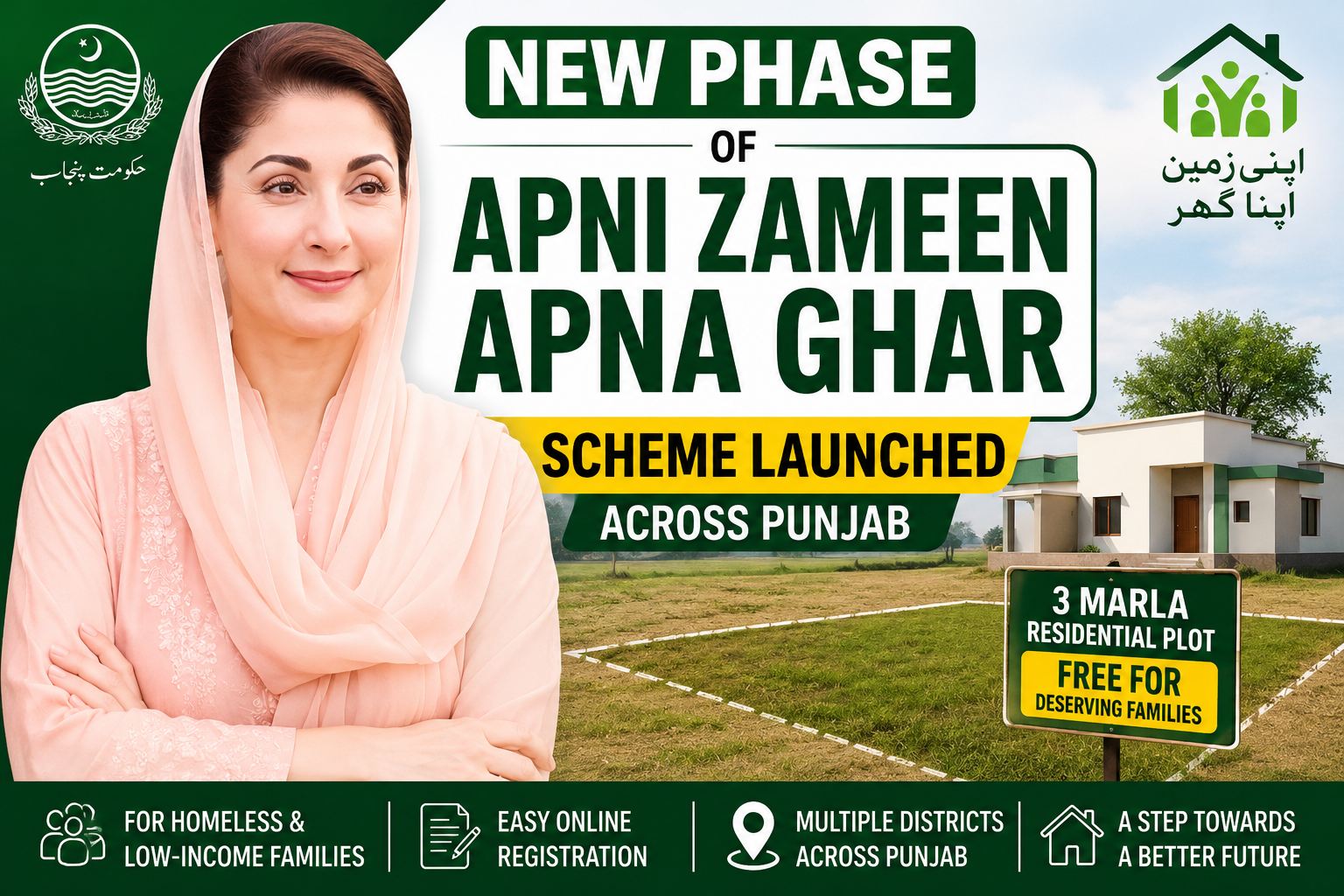
The Punjab government has launched a new phase of the Apni Zameen Apna Ghar Scheme, expanding its efforts to provide free residential plots to deserving and homeless families across the province. The initiative is part of a broader housing strategy aimed at improving access to land ownership for low-income households and helping families move toward permanent housing security.
The latest phase builds upon the initial rollout of the program, which introduced free residential plots in multiple districts of Punjab. Through this expansion, the government intends to reach more eligible families and increase the number of beneficiaries who can access land for future home construction.
What Is the Apni Zameen Apna Ghar Scheme?
Apni Zameen Apna Ghar is a public welfare housing initiative launched by the Punjab government to support citizens who do not own residential property. Under the scheme, eligible applicants are offered residential plots free of cost, allowing them to establish long-term housing stability and reduce dependence on rented accommodation.
The program focuses on families that face economic challenges and have limited access to traditional housing opportunities. By providing land ownership, the scheme seeks to create a foundation for future home development and improved living conditions.
According to official information released by the Punjab government, the scheme is being implemented in phases to ensure transparent distribution and effective management of available plots.
Key Highlights of the New Phase
The newly announced phase introduces wider coverage and increased opportunities for applicants across Punjab. Authorities have indicated that the expansion is designed to accommodate additional deserving families while maintaining eligibility standards.
Main Features
| Feature | Details |
|---|---|
| Scheme Name | Apni Zameen Apna Ghar |
| Program Type | Free Residential Plot Scheme |
| Target Beneficiaries | Homeless and low-income families |
| Plot Size | 3 Marla residential plots |
| Coverage | Multiple districts across Punjab |
| Application Method | Online registration |
| Objective | Promote housing ownership and social welfare |
The government has emphasized that allocations will be made through a structured verification process to ensure that benefits reach deserving households.
Districts Included in the Program
The scheme was initially launched across selected districts in Punjab. Official announcements indicate that the first phase covered housing schemes in 19 districts, creating opportunities for thousands of eligible applicants.
These districts include:
- Attock
- Bahawalnagar
- Bahawalpur
- Bhakkar
- Chiniot
- Faisalabad
- Gujrat
- Jhang
- Jhelum
- Kasur
- Khushab
- Layyah
- Lodhran
- Mandi Bahauddin
- Okara
- Rajanpur
- Sahiwal
- Sargodha
- Vehari
The new phase is expected to strengthen implementation within these areas while supporting future expansion plans where housing demand remains high.
Why the Scheme Matters
Access to affordable housing remains one of the biggest challenges for many families in Pakistan. Rising construction costs, increasing rental expenses, and limited land ownership opportunities have made it difficult for lower-income households to secure permanent housing.
The Apni Zameen Apna Ghar Scheme addresses this issue by focusing on one of the most important components of home ownership: access to land.
For many families, receiving a residential plot can provide long-term security and create opportunities for future investment in housing. Land ownership may also help households build financial stability over time and reduce uncertainty associated with rental living.
The program aligns with broader housing and social welfare objectives that aim to improve living standards and support economic inclusion across Punjab.
Eligibility Criteria
Applicants interested in the scheme are generally required to meet specific conditions established by the relevant authorities. While verification requirements may vary depending on official updates, the program primarily targets citizens who do not already own residential property and who meet the prescribed eligibility standards.
Authorities review applications through a verification process that may involve identity checks and assessment of applicant information before final approval.
Potential applicants are encouraged to review official guidelines carefully before submitting their registration forms.
Online Registration Process
The Punjab government has introduced digital registration mechanisms to simplify the application process and improve accessibility for citizens.
The online system is intended to reduce paperwork, increase transparency, and allow applicants to submit their information through an organized platform.
Applicants are generally required to:
- Complete the online registration form.
- Provide accurate personal information.
- Submit required identification details.
- Wait for verification and eligibility review.
- Follow official updates regarding application status.
Officials have advised citizens to use only official government channels when applying and to avoid relying on unverified sources of information.
Government Focus on Housing Development
Housing development has become an important part of Punjab’s public welfare agenda. In recent years, provincial authorities have introduced multiple initiatives aimed at improving access to housing, supporting urban development, and creating opportunities for families who face financial barriers to property ownership.
The expansion of the Apni Zameen Apna Ghar Scheme reflects this broader commitment. By allocating residential plots to eligible citizens, the government seeks to encourage planned community development while helping families establish permanent roots within their local areas.
Officials have stated that housing programs can play a significant role in improving quality of life by providing greater residential stability and supporting long-term economic participation.
Expected Benefits for Families
The launch of the new phase is expected to provide several advantages for qualifying households.
1. Opportunity for Land Ownership
For many families, purchasing residential land through the private market is financially challenging. The scheme offers an alternative pathway to ownership, helping eligible citizens acquire property that may otherwise remain out of reach.
2. Long-Term Housing Security
Owning a residential plot can provide greater stability compared to living in rented accommodation. Families may have the opportunity to plan for future home construction according to their needs and financial capacity.
3. Improved Living Standards
Access to residential land can contribute to better living conditions over time. Families can work toward developing permanent housing, which may support improved safety, comfort, and overall well-being.
4. Community Development
Housing schemes often contribute to the growth of organized residential communities. Planned development can encourage infrastructure improvements and support local economic activity.
Transparency and Verification Measures
One of the key objectives of the scheme is to ensure that benefits reach deserving applicants. To achieve this goal, authorities have introduced verification procedures designed to assess eligibility and prevent misuse of public resources.
Applicants are expected to provide accurate information during registration. Any false or misleading details may affect eligibility or lead to disqualification under applicable rules.
The use of digital registration systems also helps improve record management and streamline the application process, making it easier for authorities to review submissions efficiently.
Importance of Accurate Information During Registration
Citizens applying for the scheme should ensure that all information submitted during registration is complete and accurate. Incorrect details can cause delays in verification or create complications during the evaluation process.
Before submitting an application, applicants should carefully review:
| Registration Requirement | Purpose |
|---|---|
| CNIC Information | Identity verification |
| Personal Details | Applicant record creation |
| Contact Information | Communication regarding updates |
| Residential Information | Eligibility assessment |
| Supporting Documents | Verification process |
Providing accurate information helps authorities process applications more efficiently and improves the overall transparency of the program.
Impact on Punjab’s Housing Sector
The expansion of the Apni Zameen Apna Ghar Scheme may contribute positively to Punjab’s housing sector by increasing opportunities for property ownership among lower-income groups.
Housing experts frequently highlight the importance of land access as a foundational step toward long-term residential development. When families obtain legal ownership of residential plots, they gain an asset that can support future housing investment and economic security.
As more beneficiaries receive plots through government-supported initiatives, the program may help reduce housing inequality while encouraging planned residential growth across participating districts.
What Applicants Should Know
Individuals interested in the scheme should stay informed through official government announcements and updates. Since public welfare programs may evolve over time, applicants should regularly review eligibility requirements, registration procedures, and implementation schedules published by relevant authorities.
Applicants are also encouraged to:
- Monitor official announcements regarding new registrations.
- Verify information before submitting applications.
- Keep personal documents updated and readily available.
- Follow instructions provided through official channels.
- Avoid unofficial claims or misleading information circulating online.
The latest phase of the Apni Zameen Apna Ghar Scheme represents another step in Punjab’s ongoing efforts to expand housing opportunities for deserving citizens. Through the allocation of free residential plots and a structured application process, the initiative aims to support families seeking a pathway toward long-term housing security and property ownership across the province.